




Napoleon's Cipher: What an AI Codebreak Actually Shows
An AI has decoded a 217-year-old letter to one of Napoleon's generals in six hours. It didn't do anything a skilled person couldn't; it did the slow, painstaking part quickly. We look at how it was done, who really wrote the letter, who checked the answer, and what it shows about where AI adds value at work.
A letter nobody could read
An AI has decoded a 217-year-old letter to one of Napoleon's generals in six hours. It didn't do anything a skilled person couldn't. It did the slow, painstaking part quickly. In our experience, that is exactly where AI adds the most value at work today, provided someone checks the answer.
The letter was sent in March 1809, weeks before France went to war with Austria, to General Auguste de Marmont, who commanded the French army in Dalmatia. It was written in code: around 1,300 symbols over 24 lines, a mix of numbers, letters and invented signs. The key was lost, and for more than two centuries nobody published a full reading of it.
In September 2026, Carter Church, an AI engineer at the cybersecurity company SentinelOne, gave OpenAI's new GPT-6 Astra model one low-resolution scan of the letter and one instruction. About six hours later he had the full text in French.
We've taken a closer look at how it was done, and the real story is more useful than "AI cracks Napoleon's code". It is one of the clearest public examples so far of what current AI does well, and of what still needs a person.
Who actually wrote it
Despite the headlines, the letter wasn't written by Napoleon. It was sent by his stepson, Eugène de Beauharnais, Viceroy of Italy, and is dated 16 March 1809. Napoleon set out what it should contain, so it carries his orders, but it isn't his letter.
Marmont wasn't yet a marshal either, although several reports call him one. That July he led his army out of Croatia to join Napoleon for the victory over Austria at Wagram, and was promoted to marshal as a result.
The coded letter was reproduced in 1969 in an article by J. Vilcoq in a French military history journal. A scan of that printed page, rather than the original handwritten letter, is what the AI was given to work from.
The content is a military briefing. It sets out where French and allied troops stood across Europe, from Italy and Bavaria to Saxony and Poland, and reports that Russia was moving against Austria too. One line reads: "The Russians are marching against Austria, and the army [of] Friuli today numbers eighty thousand men." Another captures the tone: "When you receive the order to march, you must not allow yourself to be intimidated by a few troops or a gathering of rabble."
How the AI did it
The letter uses a homophonic cipher. In a simple substitution code each letter always becomes the same symbol, so you can break it by counting which symbols appear most often. A homophonic cipher gives common letters several different symbols, which defeats that approach. It was standard for military correspondence at the time: harder than a puzzle-book code, but nowhere near modern encryption.
From the published reports, the work fell into four stages.
Reading the page. Before any codebreaking, someone has to decide what the symbols are, and on a low-quality scan of a printed reproduction of a handwritten letter, that is a large part of the job. Euronews quotes Church explaining that the model "cut the 1,202 by 1,836 plate into rows, read the signs, decided which of 175 hand-drawn marks were the same sign written twice, and only then began breaking the cypher."
Using existing work. The model did not start from scratch. The cryptology historian Daniel Tant had already identified 33 of the symbols, roughly a third of the code. The AI found his work and built on it.
Solving the rest. For the remaining symbols it used simulated annealing, a well-established search technique that tries many possible answers, keeps the ones that read more like real French, and gradually settles on the best fit. The Telegraph reports that candidate words were compared against Marmont's own writing. The method has been used on codes like this for decades. What was new was the speed.
Independent checking. Church published his full working on 18 September so others could test it. Satoshi Tomokiyo, who maintains Cryptiana, a database of historical ciphers, reviewed it and marked the code as solved. Five symbols remain uncertain; Church's view is that they don't change the meaning of the letter.
What the experts said
The most revealing quotes aren't the ones in the headlines.
Church himself was measured. RuntimeWire quotes him saying the code "was not especially difficult for a specialist with time to work through it", and CTech quotes him saying it "could theoretically have been performed manually, but would have required extensive and painstaking work."
Historians were interested but cautious. Zack White, a history research fellow at the University of Portsmouth, told Live Science: "This is a really interesting use of Artificial Intelligence, and it's refreshing to see AI being used productively to try and provide a credible solution to a historical mystery." He also noted that some of the troop figures in the letter don't match the historical record.
Michael Rowe, who researches European history at King's College London, called it "a bit like a kind of Rosetta Stone", but said it "doesn't tell us anything new", because Napoleon's instructions to Eugène already set out what the letter would say. One small bonus: the decoded text completes a sentence that breaks off in the published version of those instructions.
So the accurate summary is this: a genuine, independently checked result, on a code that was hard work rather than unbreakable, confirming largely what historians expected, produced in an afternoon by one engineer with a capable model.
Why it still matters
None of that makes the story less important. The significant point isn't that AI did something no person could. It's that AI did something no person had got round to, because it was never worth the time.
Consider what the job required: transcribing a poor copy, matching hand-drawn symbols, finding a historian's earlier work, applying a codebreaking technique and reading 1809 French military language. A specialist could do every step. Doing all of them carefully, for one letter that probably confirms what was already known, is the kind of task that sits in a drawer for years. Reduce it to an afternoon and the drawer starts to empty. The New York Sun reports that this letter is one of dozens of historical codes that new AI models have recently helped unlock.
Every organisation has a drawer like that: documents that were scanned and never read, reconciliations nobody has had time to run, contracts nobody has properly reviewed. None of it is impossible. It is slow, specialist and never quite urgent. In our view, that is where AI will make its biggest difference first.
Four lessons for using AI at work
It worked because the answer could be checked. A decoded letter either reads as coherent French from 1809 or it doesn't, and it could be tested against Napoleon's instructions and the historical record. As we argued in our article on evaluating AI systems, AI output is only as valuable as your ability to tell whether it's right. Point the same model at a question nobody can check, and six hours of confident work is worth very little.
It built on what was already known. Daniel Tant's 33 symbols were the starting point. Good AI work in a business looks the same: it draws on what the organisation already knows rather than producing a fresh, unsupported answer. That is the idea behind our article on context engineering.
A named expert checked it, in public. Church shared his method, Tomokiyo reviewed it, and the five uncertain symbols were flagged rather than hidden. That is the opposite of what we described as workslop, where AI output arrives looking finished and the checking is quietly passed to whoever receives it.
The headline overstated it. "Napoleon's code cracked by AI" is a better headline than "Engineer uses AI to finish decoding a letter from Napoleon's stepson, building on a historian's work, checked by an expert, five symbols uncertain". It is also less accurate. Anyone who has watched an AI project move from a team to a steering committee to a board will recognise the pattern: each time it's retold, the claim gets shorter and bolder, and the caveats are the first thing to go.
The part that isn't about history
There is one more point worth making. GPT-6 Astra was released on 3 September 2026, and according to Axios it is the first OpenAI model rated as having "critical" cybersecurity capability, meaning it can find and exploit previously unknown weaknesses in systems without detailed human direction. Church himself works in cybersecurity.
To be clear, an 1809 cipher has nothing to do with modern encryption, which rests on mathematics that no amount of pattern-matching can shortcut. Nothing protected today is at risk because of this. But the shape of the task will be familiar to anyone in security or risk: take something messy, work out its structure, find what's already known, and work through the rest systematically without losing patience. Those same abilities make these models useful to the people defending systems, and to the people looking for a way into an old one that nobody has reviewed for years. The Napoleon letter is the harmless demonstration. The capability behind it is general.
References
The decipherment
Carter Church - Breaking the Marmont Cipher, 1809 (published 18 September 2026) https://carter.church/writeups/the-letter-to-marmont/
Carter Church - post on X announcing the decipherment https://x.com/CarterWChurch/status/2105167567706816690
Reporting
James Titcomb - Napoleon's 217-year-old coded message 'cracked by AI', The Telegraph via Yahoo (1 October 2026) https://tech.yahoo.com/ai/chatgpt/articles/napoleon-217-old-coded-message-131452147.html
Pandora Dewan - 'A kind of Rosetta Stone': AI decodes 217-year-old secret letter ordered by Napoleon, Live Science (2 October 2026) https://www.livescience.com/technology/artificial-intelligence/a-kind-of-rosetta-stone-ai-decodes-217-year-old-secret-letter-ordered-by-napoleon
Euronews - AI decodes 217-year-old Napoleonic letter in 6 hours (2 October 2026) https://www.euronews.com/2026/10/02/ai-decodes-217-year-old-napoleonic-letter-in-6-hours
CTech by Calcalist - SentinelOne AI researcher uses GPT-6 Astra to crack Napoleon cipher after 217 years (2 October 2026) https://www.calcalistech.com/ctechnews/article/h1dthf69mg
Ryan Merket - GPT-6 Astra helped decode a 217-year-old cipher letter to Napoleon's marshal, RuntimeWire (1 October 2026) https://runtimewire.com/article/gpt-6-astra-marmont-cipher-carter-church
Shaili Singh - AI Decodes Napoleon's Secret Battlefield Message After 217 Years, The New York Sun (1 October 2026) https://www.nysun.com/article/ai-decodes-napoleons-secret-battlefield-message-after-217-years
The model
Ina Fried - OpenAI releases new model GPT-6 Astra, says it may represent AGI, Axios (3 September 2026) https://www.axios.com/2026/09/03/openai-astra-gpt-6-agi-brockman
The painting
National Gallery of Art - Jacques-Louis David, The Emperor Napoleon in His Study at the Tuileries, 1812, Samuel H. Kress Collection https://www.nga.gov/artworks/46114-emperor-napoleon-his-study-tuileries
Wikipedia - The Emperor Napoleon in His Study at the Tuileries https://en.wikipedia.org/wiki/The_Emperor_Napoleon_in_His_Study_at_the_Tuileries
About the image
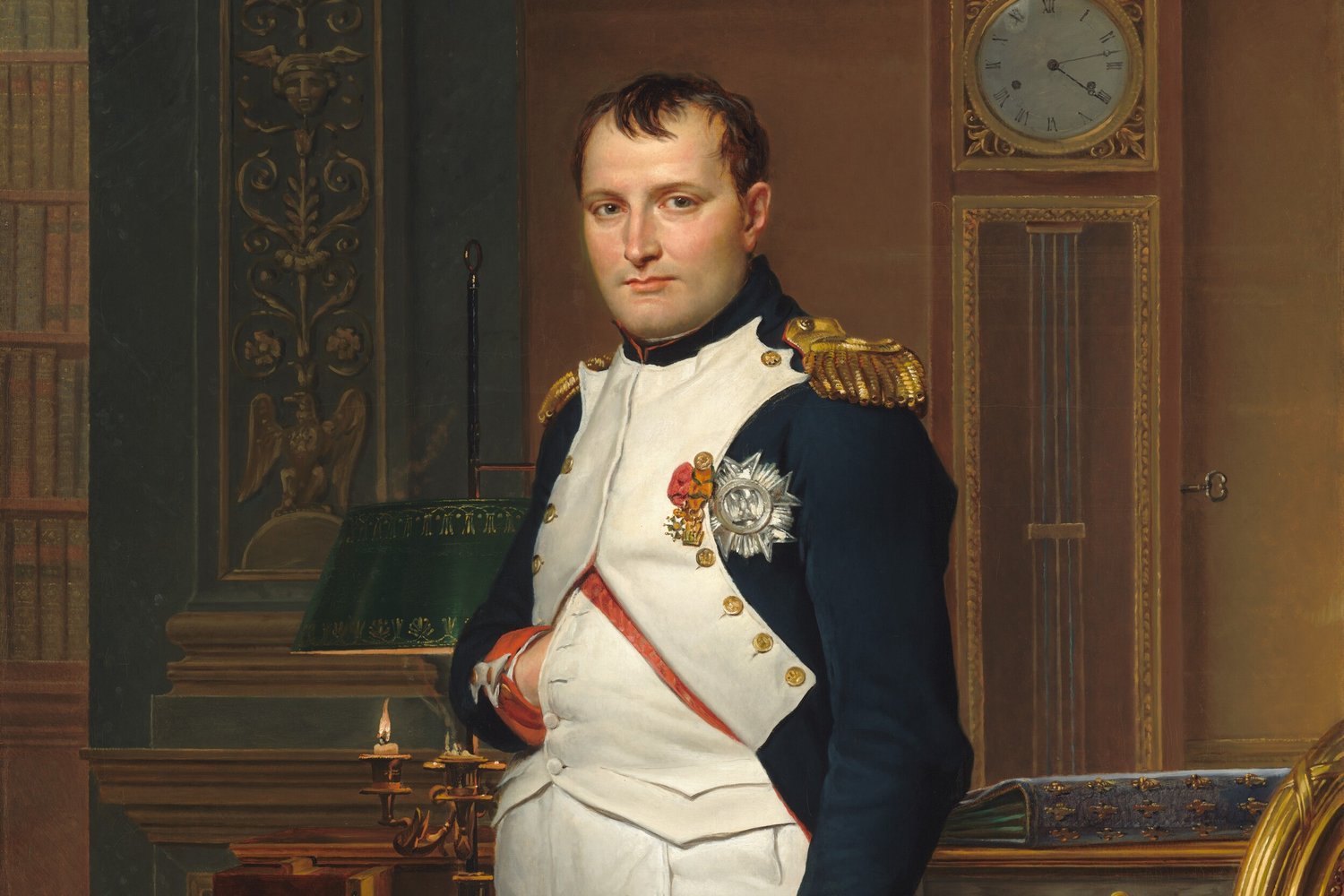
The image at the top is Jacques-Louis David's The Emperor Napoleon in His Study at the Tuileries, painted in 1812, three years after the Marmont letter, and now in the National Gallery of Art in Washington. It is full of deliberate detail. The clock shows 4:13 in the morning and the candles have burned low, to show that he has been working through the night. On the desk, the papers are marked "Code", a reference to the Code Napoléon, his civil code.
It portrays one brilliant mind working alone through the night, which is close to how the codebreak has been reported. In both cases, the reality involved rather more people.
Jacques-Louis David, The Emperor Napoleon in His Study at the Tuileries (1812), Samuel H. Kress Collection, National Gallery of Art, Washington (accession 1961.9.15). Image courtesy of the National Gallery of Art Open Access programme; the work is in the public domain. Cropped.
